


The Number That Quietly Decides Your Net Yield
Two apartments can sit in the same city at the same price, command the same rent, and still return very different amounts to their owners. The reason is usually a line that buyers glance past on the way to the sticker price: the service charge.
It is paid every year for as long as you own the property, yet it is often underestimated or not examined closely at purchase. Buyers study the price and the rent, the two numbers on the listing, and skip the recurring cost that sits between them. Yet service charges are one of the largest recurring differences between gross yield and net yield, and they are frequently underestimated. They are also not one number: what you pay may combine several separate charges, set by different parties, on different bases. This is a guide to reading that line: what it covers, why it exists, and how to compare it properly from one building to the next.
What a Service Charge Actually Covers
At its simplest, a service charge pays to keep the shared parts of a property running: common-area maintenance, landscaping, cleaning, security, lifts and shared infrastructure, insurance for common areas, and the cost of managing the building itself. Done properly, it also funds a reserve, a sinking fund set aside for large, occasional capital works like replacing chillers, lifts, or facades. That reserve is one of the items buyers often fail to ask about, and an underfunded reserve can create a risk of future special assessments.
Governance matters as much as the amount. In The Pearl, for example, The Pearl Owners Corporation (TPOC) explains that common-area budgets are approved by owners at the Annual General Meeting, run on a non-profit basis, and are externally audited. That is The Pearl’s published model, not a rule that automatically applies to every building in Qatar, but it shows what good practice looks like: a budget owners can see, question, and hold to account. A transparent, well-run charge is a sign of a well-run building, not merely a cost to minimise.
The Layers: Why There’s No Single Number
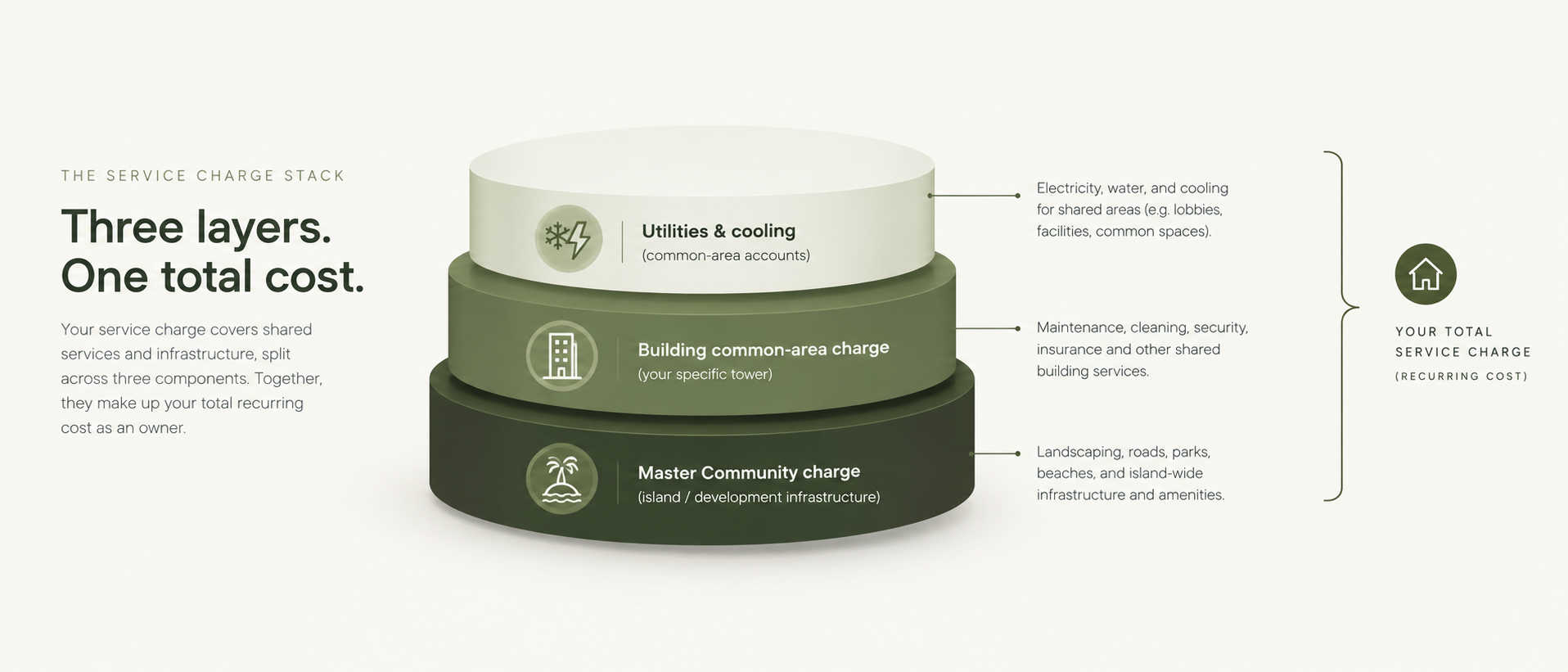
There is no single “service charge” for a development because the charge is a stack of separate items. The Pearl is the clearest worked example.
- The Master Community charge. This covers island-wide infrastructure: roads, streetlights, landscaping, waste, island security, and shared facilities, and is set by the master developer. For 2026, United Development Company (UDC) reduced this charge across The Pearl and Gewan Islands from QAR 3.50 to QAR 3.00 per square metre per month, a cut of about 14%, reflected in the third-quarter invoices with prior-period differences credited back to owners. Two things to hold onto: this is the master-community layer for The Pearl and Gewan specifically, not a universal figure, and it is only one layer, not the owner’s total bill.
- The building (common-area) charge. On top of the community charge sits a charge for your specific building, based on that building’s own annual operating budget. In The Pearl’s TPOC model, each association has its own budget, and differing running costs, systems, and amenities can make this common-area component vary from one building to the next; even two towers in the same development will rarely carry the same figure.
- Utilities and cooling. Then there are utilities. Kahramaa covers electricity and water for the common areas, and district cooling (Qatar Cool at The Pearl) covers shared spaces. Keep these separate in your head from your own unit’s utility account, which you pay directly. District cooling may include minimum or capacity charges that continue during vacancy, depending on the provider, the building, and the account terms; check the specific unit’s account rather than assuming. Exactly which utilities fall inside a service charge and which are billed to you directly depends on the building’s governing documents and billing arrangements.
Put the layers together, and the point is clear: “What are the service charges at The Pearl?” has no single answer. The honest answer is always “in which building, and including which layers?”
How the Rules Work, and What Depends on the Building
Owners of jointly owned property, apartments and floors within a shared building, sit inside a framework of owners’ associations, and the sector as a whole is overseen by Aqarat, Qatar’s Real Estate Regulatory Authority, which publishes the relevant regulatory materials and legislation. The obligations that affect an owner may arise from current legislation, the property’s governing documents, and contractual and title arrangements together, and the relative weight of each depends on the property and the issue involved. In day-to-day practice, much of what governs your bill sits in the building’s own documents: the Sale and Purchase Agreement, the association’s rules, and the approved annual budget.
Qatar’s framework for jointly owned property is also evolving, and this article is a practical guide to reading and comparing service charges, not a legal interpretation of the governing legislation or any implementing rules. For a specific dispute or transaction, confirm the current legislation, review the building’s governing documents, and take qualified Qatar legal advice.
One practical consequence: we have not identified a public, Qatar-wide service-charge index that lets buyers compare building-level charges on a consistent basis. In other markets, a central platform publishes approved rates per square metre; here, comparison is a document-based exercise. That places the burden on the buyer — which is exactly why a method matters.
How to Compare One Building Against Another
Comparing service charges properly means asking for the paperwork, not a verbal figure. Before you commit, request:
- The current annual budget and the approved service-charge schedule.
- The exact components: master community, building common area, reserve fund, utilities and cooling, parking, and any special assessments, and the basis they are charged on (per sqm per month, per sqm per year, or by participation quota).
- Two to three years of actual statements, so you can see whether the charge is rising, stable, or falling.
- The reserve-fund balance and any planned major works — an underfunded reserve is a warning sign of special assessments to come.
- Any recent or pending special assessments, the arrears and collection position, and who manages the building.
- Whether the quoted figure includes your own unit’s utilities or only the common-area accounts.
Then convert everything to the same basis: total building and community cost in QAR per square metre per year, with utilities, cooling, reserve contributions, and any special assessments stated separately rather than blended into one figure. Forcing genuinely different costs into a single number hides what you are actually comparing. And always run the result through net yield, not gross. Where a client wants it, Coreo will request and interpret this document pack on their behalf wherever it can be lawfully obtained.
The Cost of Getting It Wrong: A Hypothetical Illustration
Consider two apartments a buyer is weighing. Everything looks identical on the listing: same price, same rent, but the service charge differs by QAR 40 per square metre per year. On a 120 sqm unit, that is QAR 4,800 a year, every year.
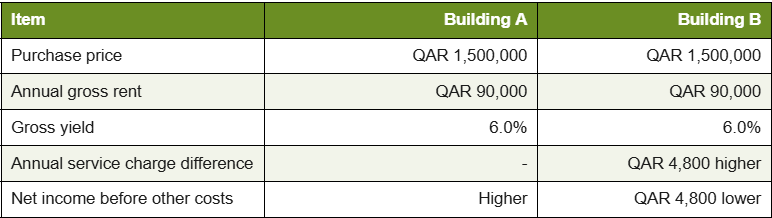
Both units show the same 6% gross yield, the number a listing would lead with. But Building B hands back QAR 4,800 less every year before any other costs, and over a long hold that recurring difference can become material, especially if charges rise or the money saved is invested rather than spent. Two identical-looking investments; two different outcomes; one line on an invoice.
What This Means for Buyers and Investors
The cheapest building is not automatically the best investment. The better question is whether the charge is transparent, adequately funded, and proportionate to the services and risks it covers. A very low charge can signal underfunded maintenance, and a future special assessment when the bill finally lands. A higher charge can be entirely rational if it pays for services, insurance, reserves, and amenities that keep the building desirable, support tenant demand, and protect resale value.
The headline rate is the easiest number to find and the least complete picture of what you are buying into. Before you commit, get the building’s budget, history, and reserve position, and compare them against the rent, not instead of it. That is the difference between a gross yield on paper and a net yield in your account.
Comparing two properties and not sure what the service charges really cost?
Coreo can help you obtain and interpret a building’s budget, history, and reserve position, where those documents can be lawfully accessed, so you can compare the true cost of ownership, not just the advertised rate. Get in touch before you decide.
Sources
• Aqarat, Qatar’s Real Estate Regulatory Authority, official website, the sector regulator, which publishes regulatory materials and legislation relevant to Qatar’s real estate market.
• The Pearl Owners Corporation (TPOC), “A Guide To Your Service Charges”, for The Pearl’s charge layers, budgeting, reserve funds, AGM approval, and audit — cited as The Pearl’s published model, not a Qatar-wide rule.
• United Development Company (UDC), official announcement, 4 July 2026, reported by The Peninsula, UDC’s 2026 reduction of the Master Community Service Charge across The Pearl and Gewan Islands from QAR 3.50 to QAR 3.00 per sqm per month, effective for 2026 and reflected from the third-quarter invoices, with prior-period differences credited to owners.
This guide is provided for general information based on Coreo’s market experience. It is not legal, financial, tax, or investment advice. All figures are dated to September 2026, and the comparison example is hypothetical and illustrative, not a market benchmark. Service charges vary by building and change over time, and the rules governing jointly owned property can change; always verify the specific building’s current budget and the current legal position, and take professional advice before making a decision.





.png)