


The First Decision Isn’t Which Building
Most buyers start with the building: the view, the finish, the address. The more useful first question is quieter: what is this property actually for? A home you will live in and a unit you will rent out are judged by different criteria, and a buyer who hasn't decided which one they are buying tends to apply both criteria at once. The result is a compromise in both directions: a property you love that tenants will not pay for, or a high-yielding unit you would never want to come home to.
This does not mean the two are opposites. A good home can also rent well, and a good rental can be a pleasant place to live. But before you compare buildings, decide what the property must do first, and what it must do well enough. If it is your home, define the life it has to support. If it is an investment, define the income, the risk, and the exit. You can ask a property to do both jobs. Expect trade-offs, and know which objective wins when they collide.
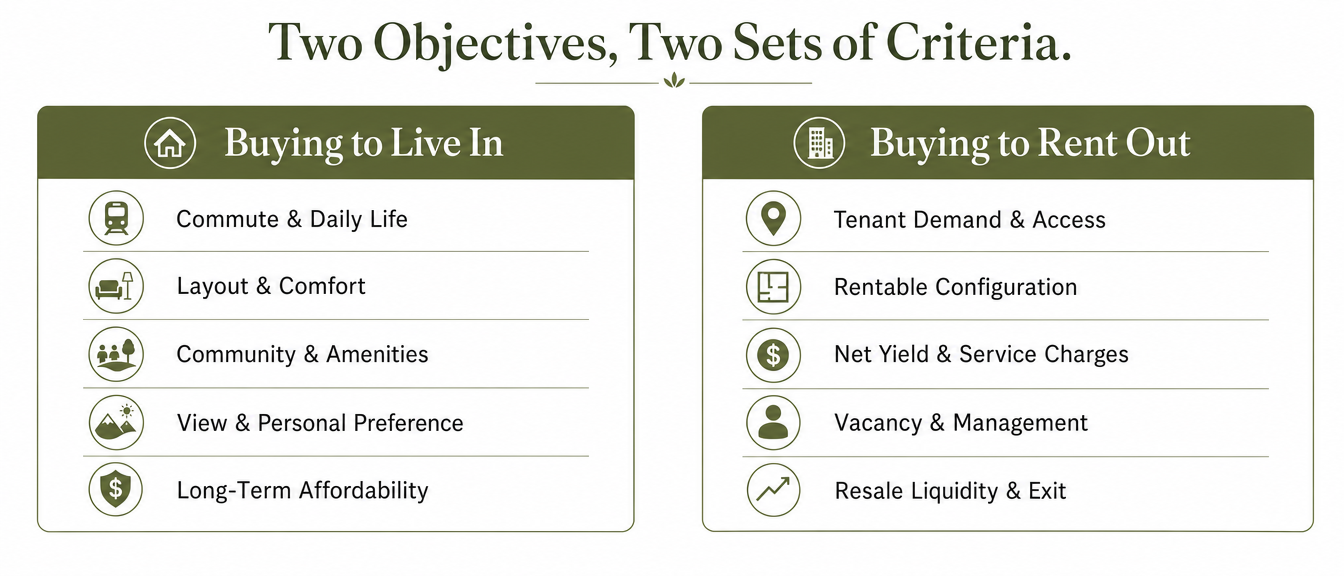
Buying to Live In: What Matters
When the property is your home, the criteria are mostly personal, though they still have to be tested against affordability, building quality, and future flexibility.
- Location relative to your life. Not the most fashionable address: the one closest to your work, your children’s school, and the people you see. A twenty-minute commute you make twice a day, five days a week, will shape your life far more than a marina view you glance at on weekends.
- Space and layout. You are optimising for how your household actually lives: a room that works as a home office, a kitchen you will cook in, storage, natural light. These features matter enormously to you, and may add little to what a tenant would pay. That is fine, because you are not buying this to rent out.
- Floor and view. A high floor with a sea view is worth paying for if you wake up to it every morning. Just be clear-eyed that the premium is a lifestyle purchase; as we will see, it rarely returns a proportional amount in rent.
- Total housing cost, not just price. A lifestyle feature is worth paying for, but know what it costs you. Add the service charges, the district cooling, the maintenance, and any financing to the sticker price. The question is not “can I afford the apartment?” It is “can I comfortably afford to live in it, every month, for years?”
- Resale resilience, secondary, not ignored. Resale can sit lower on your list than daily comfort, but only if you have a long horizon and can ride out an illiquid market. You should still buy something that holds its value and could be sold or rented out if life changes: check the title, the building’s management quality, the service-charge history, and any restrictions on leasing or resale before you fall for the finish.
Buying to Rent Out: What Matters
When the property is an investment, do not let personal taste overrule the economics. The criteria are financial.
- Location relative to tenant demand. The question is not where you would want to live; it is where tenants are actively searching, and at what rent. An area that would not be your first choice as a resident may be the better investment if the demand and the economics are there.
- Gross yield versus net yield. Get this straight before you look at any headline number. Gross yield is annual rent divided by the purchase price. Net yield is what is left after the costs of owning and running the unit: service charges, maintenance, management, vacancy, as a share of everything you invested. Financing sits on top of that: how you fund the purchase changes the return on your own cash, so weigh it separately. A building with a strong gross yield and heavy service charges can deliver a mediocre net one. Always ask which number you are being shown.
- Unit type and the yield it supports. One- and two-bedroom apartments are important rental segments, but the right unit size depends on the tenant pool, location, price point, and building. In ValuStrat’s Q2 2026 Qatar review, apartments showed higher average gross yields than villas: reported average residential gross yields of 5.6% overall, with apartments at 8.0% and villas at 4.4%. These are market-level gross indicators, not net returns or a forecast for any specific property, and they do not mean every apartment will out-earn every villa.
Note on the figures: gross yield does not account for service charges, maintenance, management, vacancy, financing, taxes, or transaction costs. Reporting methodologies differ between market reports, so figures from different sources should not be compared without checking how each is defined and measured.
- Service charges and running costs. These vary widely between buildings, sometimes within the same development, and they come off your return every year. In some towers, district cooling may include capacity or minimum charges that continue while the unit is vacant, depending on the provider, building, and account terms. Underwrite the specific building, not the area’s reputation.
- Vacancy. No unit should be underwritten on the assumption that it will be occupied 100% of the time. As an illustrative planning assumption, some investors model four to eight weeks of vacancy a year and test how sensitive the result is to longer or shorter stretches: a scenario to stress, not a Qatar-wide standard. The real test: could you cover the mortgage and service charges through a quiet stretch between tenants?
- Management, especially from abroad. If you may leave Qatar, someone has to handle the property: leasing, repairs, tenant issues, payments. That is either your time or a management fee. Either way, it is a real cost that belongs in the net-yield calculation.
- Exit and liquidity. One day you will sell. Areas with established transaction and leasing activity may offer deeper pools of buyers and tenants than newer districts, but deeper demand is not the same as a fast sale, and resale times move with the market, the unit type, the price, and condition. The Ministry of Justice’s weekly Real Estate Bulletin is a useful public gauge here. Recent bulletins have listed The Pearl Island and Lusail 69 among areas with concentrated registered sales, while ValuStrat’s Q2 2026 review also identified The Pearl and Lusail among the quarter’s more active locations. This should not be read as a guarantee of resale speed or future liquidity. Know how you would exit before you enter.

The Floor Test: A Hypothetical Example
Here is the clearest way to feel the difference between the two mindsets. Imagine the same building, two apartments, two buyers.
The buyer choosing a home takes a high floor with a marina view and pays, say, a QAR 300,000 premium over an equivalent lower unit for the light and the outlook. For them, that can be money well spent; it is where they will live.
The buyer choosing a rental looks at the same premium differently. If the higher-floor unit rents for only QAR 700 more a month, that is QAR 8,400 a year, a gross yield of under 3% on the extra QAR 300,000. From a pure income view, the premium does not pay for itself, so the investor takes the cheaper floor.
These figures are hypothetical, for illustration only, not a benchmark for any real building.
But even here, the investor should not conclude that lower is always better. A better view may reduce vacancy, attract a different tenant segment, and support resale demand, value that does not show up neatly in a monthly rent line. The point is not that views are worthless to investors; it is that the home-buyer and the investor are pricing the same feature for entirely different reasons.
“Live Now, Rent Later”: Three Ways to Play It
Many buyers plan to live in the property for a few years, then rent it out when they leave Qatar. It can be a sound plan, but its success depends on the purchase price, the holding period, the rental economics, the financing, and how the property will be managed after you leave Qatar. “Buying for both” is not one strategy; it is a choice between three.
- Lifestyle-first. Buy the home you will genuinely enjoy, while checking that it would still rent well. The risk: you may overpay for features tenants will not value.
- Rental-first. Buy a unit that underwrites well as an investment and accept some lifestyle compromises while you live there. The risk: you spend years in a property optimised for a spreadsheet, not for you.
- Balanced. Set a minimum standard for both, a home comfortable enough to live in and economics sound enough to rent out, and accept that it will not be the best possible version of either.
For most people making this move, the balanced approach is the honest one. Just do not assume the rental case should automatically win. If you will live there for years before letting it, those years of living are real value too. Decide which objective leads, and price the compromise with your eyes open.
A Decision Scorecard
Before you start viewing, work through these honestly.
- What is the property’s primary objective: a home, rental income, residency, capital preservation, or a mix? And what is the minimum acceptable outcome for the secondary one?
- How long do you realistically expect to hold it? If it is short, around two to three years, test carefully whether the benefits of ownership can offset the acquisition, financing, and selling costs.
- If you leave Qatar, will you sell or rent it out, and could that answer change with tax, distance, or management realities?
- What is the net yield after service charges, maintenance, vacancy, management, and financing, not the gross headline?
- How much cash reserve remains after you complete? Could you carry the property for twelve months with no rent if you had to?
- Who manages it if you are not here?
- What is your exit plan if the buyer or tenant you are counting on does not appear?
If you can answer these, you will be far better placed to spot which properties fit your objective, and which only look like they do.

The Honest Answer
Neither strategy is better than the other. A home is judged by the life it enables; a rental by risk-adjusted income, tenant demand, and a clean exit. Some properties do both jobs respectably, but they rarely maximise either, and that is a trade-off to accept knowingly, not stumble into.
And to be clear: living in a home is not “not an investment.” It builds equity, it carries an opportunity cost, and it is part of how your wealth is allocated. It simply should not be judged by rental yield alone.
The wrong purchase is not the one that chose lifestyle over yield, or yield over lifestyle. It is the one whose objective was never defined: bought because it was beautiful, or because the yield looked good, without ever deciding what the property was actually for.
Buying a home, an income asset, or a bit of both?
Coreo can help you define the objective first and then find the property that fits it, with an honest read on how it would live and how it would rent. Get in touch, and we will help you decide what the property needs to do before you decide which one to buy.
Sources
Ministry of Justice, Department of Real Estate Registration, Real Estate Bulletin. The Ministry publishes weekly, monthly, quarterly, and annual real-estate bulletins containing registered transaction information. A representative weekly bulletin covering 23-27 August 2026 listed The Pearl Island and Lusail 69 among areas with concentrated registered sales.
Public Authority for Regulating Real Estate: Aqarat, Qatar Real Estate Platform indicators (aqarat.gov.qa; qrep.aqarat.gov.qa). Aqarat identifies its sales indicators as sourced from the Ministry of Justice and its rental-transaction indicators as sourced from the Ministry of Municipality. The indicators should be read with the period and definition displayed on the platform at the time of review; they are not a guarantee of future transaction volume, rental demand, or resale speed.
ValuStrat “Qatar Property Market Rebounds as Q2 Sales Rise 23.6%”, 10 August 2026. The report states that average residential gross yields were 5.6% overall in Q2 2026, with apartments at 8.0% and villas at 4.4%. In this article, gross yield means annual rent divided by purchase price before ownership, financing, tax, and transaction costs. The ValuStrat figures are market-level indicators, not net returns or forecasts for any specific property.
This guide is provided for general information based on Coreo’s market experience. It is not financial, legal, tax, or investment advice. All figures are dated to September 2026, and the floor-test example is hypothetical and illustrative, not a market benchmark. Rental yields, service charges, mortgage terms, and market conditions change. Consult a qualified financial adviser before making a purchase decision.





.png)