


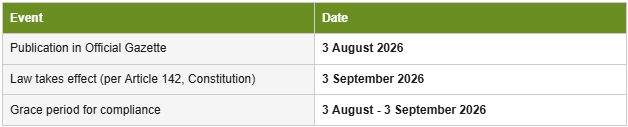
On 3 August 2026, the State of Qatar published Law No. 8 of 2026 in the Official Gazette (Issue No. 13 of 2026, Ministry of Justice), amending certain provisions of Law No. 4 of 2008 concerning the leasing of real estate. Under Article 142 of Qatar’s Permanent Constitution, the amendments take effect one month after publication, on 3 September 2026.
The Ministry of Municipality confirmed that the amendments are designed to enhance investment attractiveness, streamline procedures, safeguard the rights of all parties to the lease relationship, and improve the efficiency of the rental dispute resolution system. HE Eng. Ali bin Mohammed bin Ali Al Ali, Undersecretary of the Ministry of Municipality, called on all stakeholders to review the amendments and bring their status into compliance before the effective date.
This analysis covers each amendment, its practical implications, and the actions required for landlords, tenants, and property managers operating in Qatar.
1. Registration Fee: Fixed at QAR 250 Per Unit
The most immediately impactful change is the introduction of a flat registration fee of QAR 250 for each residential, commercial, or other unit included in a lease registration transaction, based on the units listed in the property’s building permit.
This replaces the previous fee structure, which was calculated at 0.5% of the unit’s annual rental value, subject to a minimum of QAR 250 and a maximum of QAR 2,500.
Registration Fee Comparison: Previous vs. Amended
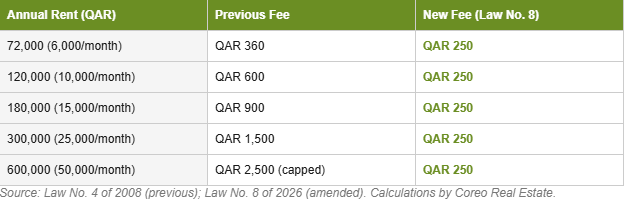
The reduction is most significant for premium property transactions. A landlord registering a lease with an annual rental value of QAR 600,000 (QAR 50,000 per month) previously paid QAR 2,500. Under the amended law, the fee is QAR 250, a 90% reduction.
Where multiple units within the same property are registered in a single transaction, the QAR 250 fee applies separately to each unit. The fee may be further adjusted by a decision of the Council of Ministers upon the proposal of the relevant minister.
2. Dispute Resolution: Mandatory Committee Jurisdiction
The amended law grants the Rental Disputes Settlement Committee exclusive and expedited jurisdiction over all disputes arising from landlord-tenant relationships. This includes disputes connected to exceptional cases previously excluded from the general application of the law under Article 2.
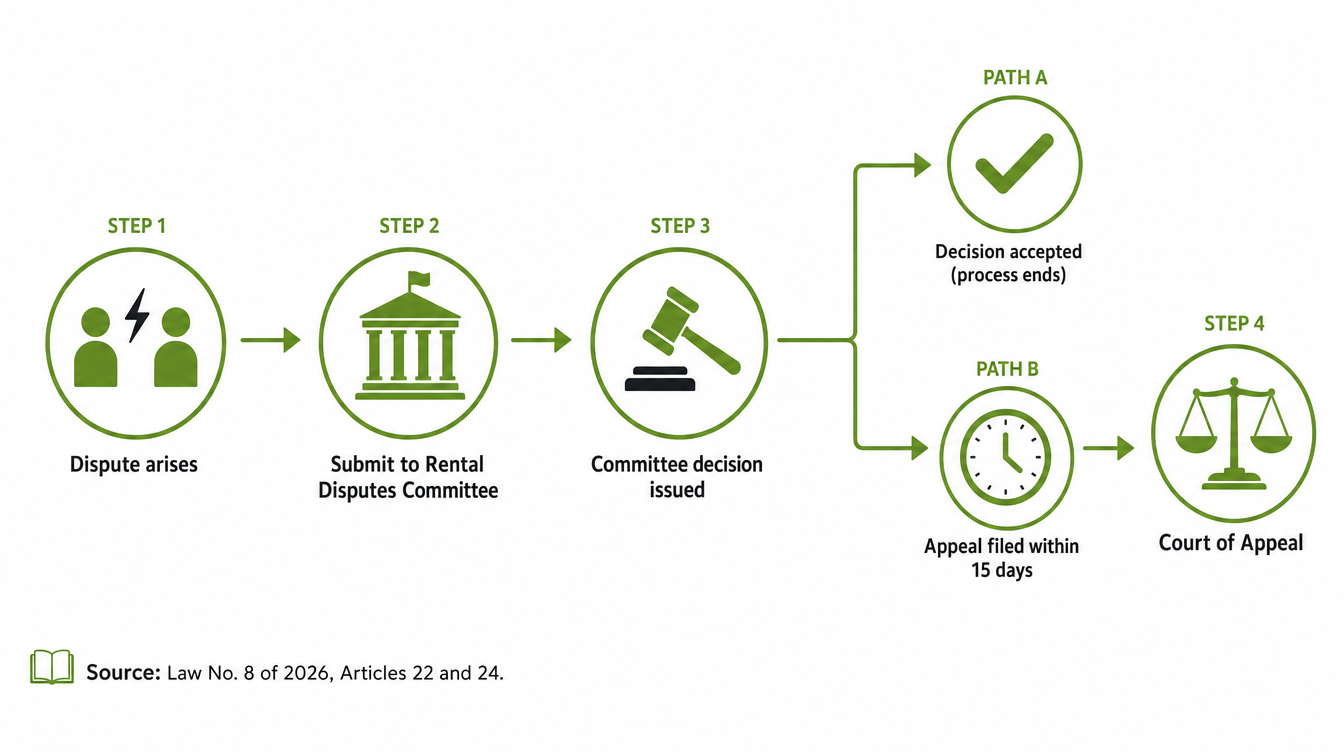
A critical procedural requirement applies: rental disputes falling within the committee’s jurisdiction cannot be filed directly with the courts. All claims must first be submitted to the Rental Disputes Settlement Committee. Court lawsuits concerning rental disputes are inadmissible unless the committee has first issued a decision. Appeals from committee decisions lie exclusively with the Court of Appeal. A separate Cabinet decision will establish the procedures for submitting and reviewing applications, the rules followed before the committee, the method for enforcing its decisions, and the applicable fees.
3. Appeal Period: 15 Days
Landlords, tenants, and other interested parties may challenge the committee’s decisions before the Court of Appeal, subject to a strict 15-day filing deadline.
The calculation of the 15 days depends on how the decision is delivered. If the decision is rendered in the presence of the parties, the 15-day period begins on the date the decision is issued. If the decision is issued in absentia, the period begins on the day following formal notification of the decision.
Failure to file within this window results in the forfeiture of the right to appeal. All parties to rental disputes should implement internal tracking of committee decision and notification dates to ensure compliance.
4. State Property Subletting: Mandatory Registration
Law No. 8 of 2026 introduces a new provision by adding Article 20 bis, which imposes a registration obligation on beneficiaries of public and private state property who enter into lease agreements with third parties.
The requirement applies exclusively where the beneficiary’s original agreement with the state already permits subletting. The amendment does not independently create new subletting rights. Where the condition is met, the beneficiary must register the lease with the Real Estate Lease Registration Office within two months of the agreement’s execution date. These registrations are exempt from the QAR 250 fee.
5. Penalties for Non-Compliance
The amended law establishes a maximum fine of QAR 10,000 for failure to meet registration requirements within the prescribed two-month period. This penalty applies to two categories of obligated parties: landlords who fail to register a lease agreement (an obligation that existed under the original Article 3 of Law No. 4 of 2008), and beneficiaries of state property who fail to register applicable third-party lease agreements under the new Article 20 bis.
Settlement Terms: Previous vs. Amended
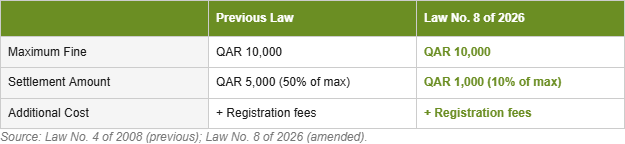
Under the amended law, the settlement amount has been reduced from QAR 5,000 (50% of the maximum fine) to QAR 1,000 (10% of the maximum fine), in addition to applicable registration fees. Settlement is available before a final judgment is issued (Source: Law No. 4 of 2008, as amended).
The Gulf Times characterised this reduction as a measure “aimed at drawing non-compliant parties into the system rather than into court,” reflecting the government’s preference for incentivising compliance over imposing punitive measures.
6. Key Dates

7. Recommended Actions
For landlords and property owners: Ensure all new lease agreements are executed in writing, contain all legally required information, and are registered with the Real Estate Lease Registration Office within two months of execution. Budget QAR 250 per unit for registration. Review compliance status of all existing leases before 3 September 2026.
For beneficiaries of state property: Review original agreements to confirm whether subletting to third parties is permitted. Where applicable, register qualifying lease agreements within two months of execution. These registrations are exempt from the QAR 250 fee.
For tenants: Be aware that all rental disputes must now be submitted to the Rental Disputes Settlement Committee before any court action. If a committee decision is issued, the appeal deadline is 15 days; track notification dates carefully.
For all parties: Settlement of registration violations is now available at QAR 1,000 plus registration fees, reduced from QAR 5,000. Parties with outstanding registration obligations should consider early settlement before a final judgment is issued.
Sources
- Law No. 8 of 2026, Official Gazette Issue No. 13 of 2026, Ministry of Justice, State of Qatar
- Law No. 4 of 2008 on the Leasing of Real Estate, State of Qatar
- Article 142, Permanent Constitution of the State of Qatar





.png)